UPPBiz Solutions
SWOT Guide and Template Fill in Template
SWOT Guide and Template Fill in Template
Couldn't load pickup availability
Share
The document is a comprehensive guide on conducting SWOT analysis for personal and professional development, detailing its history, types, and step-by-step instructions for creating and utilizing a SWOT analysis effectively.
History and Development of SWOT Analysis
SWOT analysis, initially developed in the 1960s by Albert S. Humphreys, serves as a strategic tool for assessing strengths, weaknesses, opportunities, and threats in both corporate and personal contexts.
- Introduced by Albert S. Humphreys at Stanford Research Institute.
- Aimed to improve corporate planning and understand failures in strategic planning.
- Evolved into a widely taught framework in universities and professional development programs.
Types of SWOT Analysis
Various types of SWOT analysis exist, each tailored for specific contexts such as personal development, competitor analysis, and strategic planning.
- Traditional SWOT: Standard framework for assessing businesses or individuals.
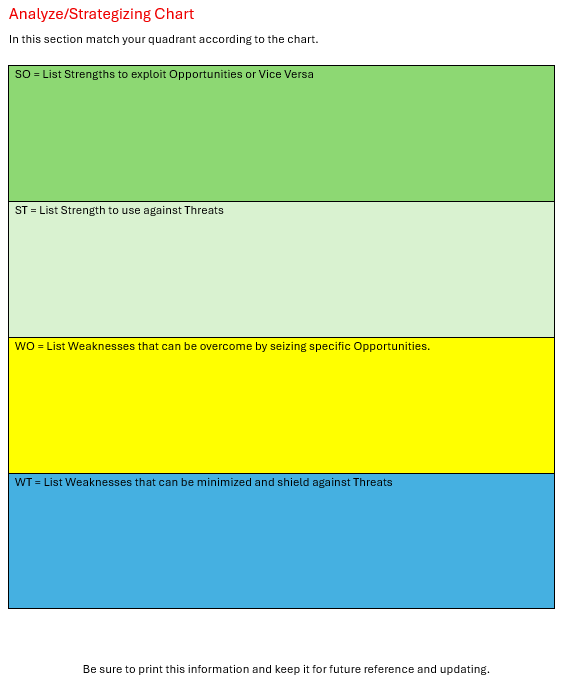
- TOWS Matrix: Aligns internal and external factors to develop effective strategies.
- Personal SWOT: Focuses on individual strengths and areas for growth.
- Competitive SWOT: Compares businesses against competitors.
- Environmental SWOT: Integrates PEST analysis into the SWOT framework.
- Scenario-Based SWOT: Tests multiple future outcomes.
- Product/Project SWOT: Focuses on specific products or initiatives.
- Organizational SWOT: Assesses internal departments and structures.
Steps to Conduct a SWOT Analysis
A structured approach to conducting a SWOT analysis involves defining objectives, creating a grid, brainstorming ideas, analyzing the data, and taking action.
- Step 1: Define the objective clearly, addressing the 'what' and 'why.'
- Step 2: Create a 4-quadrant grid to categorize strengths, weaknesses, opportunities, and threats.
- Step 3: Brainstorm and fill each section using self-assessment results.
- Step 4: Analyze and prioritize data to identify actionable strategies.
- Step 5: Develop an action plan with SMART goals.
- Step 6: Review and adjust the SWOT analysis periodically.
Benefits of Creating a SWOT Analysis
Conducting a SWOT analysis provides numerous advantages for personal and professional growth, offering a clear overview of relevant data.
- Concise overview of strengths, weaknesses, opportunities, and threats.
- Categorizes information for strategic planning and forecasting.
- Reveals vulnerabilities and potential hazards affecting progress.
- Provides raw data for informed decision-making.
Questions for Identifying Strengths, Weaknesses, Opportunities, and Threats
A series of targeted questions helps individuals effectively identify their strengths, weaknesses, opportunities, and threats.
- Strengths: Identify unique talents, achievements, and resources.
- Weaknesses: Recognize areas for improvement and negative behaviors.
- Opportunities: Explore trends, unmet needs, and potential collaborations.
- Threats: Assess external pressures, risks, and personal blind spots.
Sample SWOT Profile and Action Plan
An example of a SWOT profile illustrates how to analyze entrepreneurial readiness and develop actionable strategies.
- A sample profile highlights strengths such as adaptability and persistence, while also acknowledging weaknesses like poor networking.
- The action plan includes investigating entrepreneurial opportunities and expanding networking efforts.
- SMART goal example: Identify suitable entrepreneurial paths within three days through thorough research and a comprehensive SWOT analysis.